zenalead

New Energy Works Joins Passive House Accelerator as an Innovation Partner

By the Passive House Accelerator Team

Passive House Accelerator is pleased to announce that New Energy Works has joined the Accelerator community as an Innovation Partner. The employee-owned firm operates on two coasts, with offices in Portland, Oregon, and Farmington, New York, which is roughly twenty miles southeast of Rochester. New Energy Works operates as a design-build firm, and they have spent decades learning the intricacies of building with wood. From crafting custom timber frames to utilizing novel mass timber components, their expertise with wood makes them an ideal partner for projects where natural materials take center stage. Their extensive history with timber framing allowed them to easily transition into the panelization space, where they have been operating since the 1990s. The expertise has allowed them to develop and refine a system of prefabricated, panelized building components that can be used in high-performance and Passive House construction. New Energy Works’ panelized system has been used on numerous projects that have obtained Phius certification.

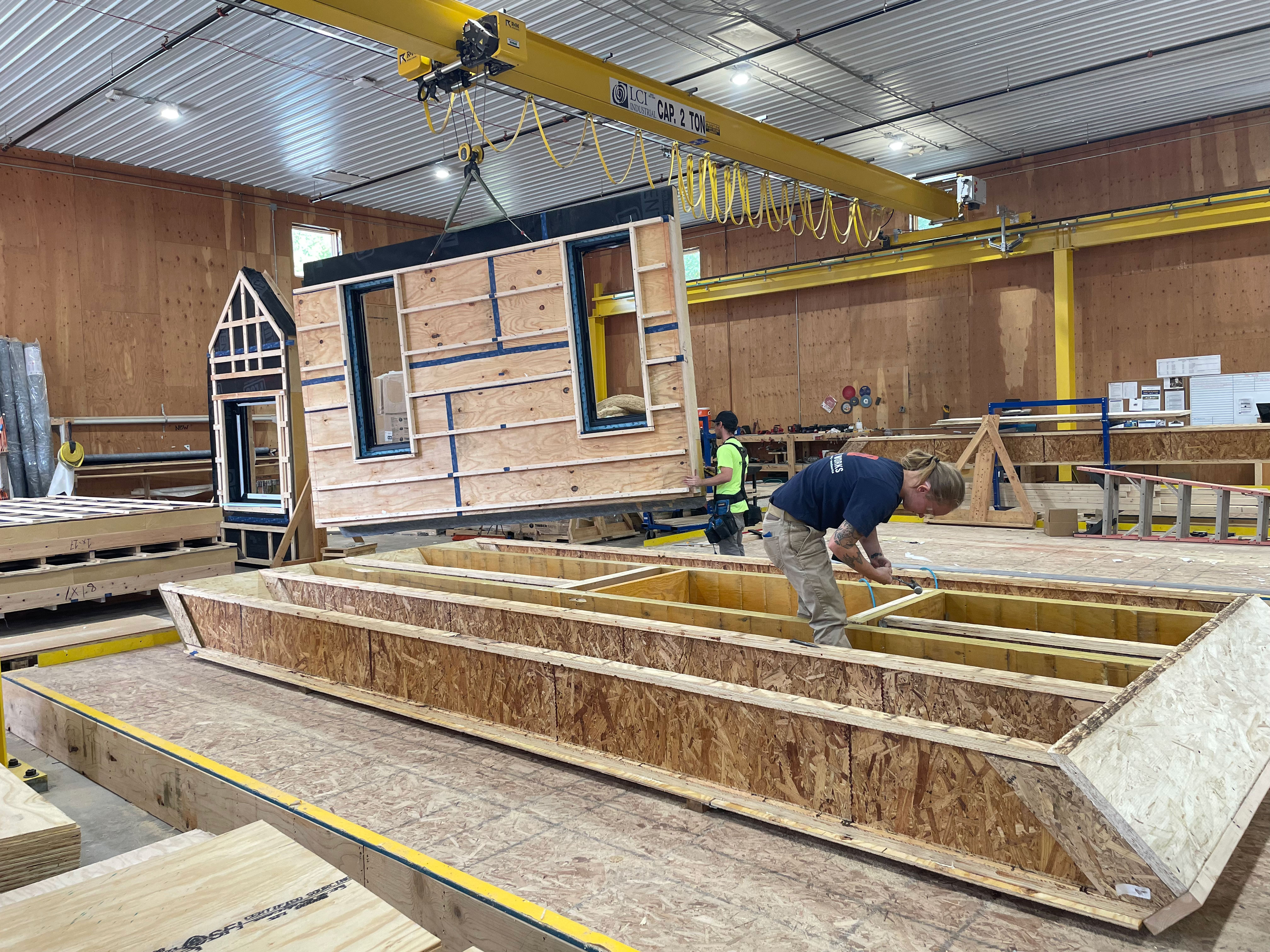
Cranes are used to lift New Energy Works' panels into position.

At the heart of their work in prefab is the XP Series assemblies, a panelized and high-performance wall and roof system designed and crafted in the United States. The “XP” stands for exterior perm, as the system is designed as an air-tight, vapor permeable assembly to shed bulk water, allow vapor diffusion, and optimize drying potential. Panels come equipped with a layer of continuous insulation made from rigid wood fiber in addition to optional dense-packed wood fiber cavity insulation. The cavity and rigid insulation depths can be adjusted to meet the needs and performance goals of any projects. The XP10 is the uninsulated, open cavity option, while the XP20 is a more robust, closed cavity option that shifts the sheathing layer to the interior and comes with dense-packed wood fiber insulation (see Figure 1). This interior sheathing serves not only as the structural sheathing layer but also doubles as the primary air barrier and vapor retarder—a shift made possible through off site construction. The panels for the enclosure system arrive at the site with detailed sequencing and installation plans, so they can be easily installed by New Energy Works’ in-house crew or local on-site labor. 

The XP20 contains structural sheathing, continuous outboard wood fiber insulation, a weather-resistive and vapor-control layer, rain screen, and strapping all pre-installed. Image courtesy of New Energy Works

The assembly process is quicker than traditional on-site framing, but that is only one benefit of prefabrication. By building the enclosure system off-site, in a climate-controlled shop, New Energy Works can reduce material waste, ensure quality control, and keep crews working in a safer, more comfortable environment. Panels are not cookie-cutter components; rather, they are built by an in-house engineering team that models each assembly and is in constant communication with the design team. The teams act like two hemispheres of a single brain rather than two separate entities. Additionally, the design team works with outside architects during a project’s schematic design to ensure it is optimized for panelized construction.

Driving down operational carbon through high-performance design and construction is certainly a priority, but New Energy Works also strives to reduce projects’ embodied carbon. To that end, New Energy Works has a deep commitment to sustainable forestry. They belong to the Northeast Sustainable Energy Association (NESEA), the Building Forward Collaborative, and have been members of the Timber Framers Guild since 1984.

New Energy Works regularly shares what they’ve learned over the years. As a case in point, New Energy Works Building Systems Specialist Steve Hessler will be presenting a three-part series on Integrated Design for Manufacture and Assembly (IDfMA). Continuing education credits for attendees are available.

  • SESSION 1 (August 26, 12:00 pm to 1:00 pm ET) – From BIM to Low Carbon Manufacturing: Why Architects Must Think in Parts

  • SESSION 2 (September 2, 12:00 pm to 1:00 pm ET) – The IDfMA Roadmap: From Concept Design to GR3 Fabrication Review

  • SESSION 3 (September 9, 12:00 pm to 1:00 pm ET) – Low-Carbon Outcomes: Vapor-Open Systems, Carbon Accounting & Circular Design Through IDfMA

crane2

“We’re excited to be part of the Passive House Accelerator community and to continue watching the passive building movement grow," said New Energy Works Enclosure Division Director Brayn Bleier. "We’ve seen the conversation evolve from an early focus on simply achieving airtightness and high R-values to a much broader consideration of the sustainability, durability, resiliency, and health of the buildings we create. We think that shift is incredibly important. At the same time, we’re asking how we can make the process of delivering high-performance buildings more repeatable and reliable, even when every building is unique. That’s a big part of the thinking behind our XP series assemblies. Through our iDFMA process, we’re able to fully think through the building and the assembly process before we ever make any sawdust. By coordinating all the details, interfaces, and sequencing in the digital environment and then bringing that thinking into a controlled manufacturing environment, we can improve both the performance of the building and the consistency of how it gets built. We see tremendous opportunity at the intersection of high-performance building and offsite manufacturing, and we’re excited to be part of that ongoing conversation.”

“Airtightness and thermal-bridge-free design are crucial to Passive House construction. They’re also where a lot of projects get stuck,” said Passive House Accelerator Director Zack Semke. “New Energy Works has spent decades refining their panelized systems to tackle that. Their expertise in prefabrication, as well as conventional timber framing and sustainably sourced timber, is a real gift to the Accelerator community. We’re delighted to welcome them as an Innovation Partner.”

Passive House Accelerator Founder Michael Ingui said, “New Energy Works comes at high performance from the craft side—they’re timber framers first, and you can feel that care in everything they make. What excites me is how they’ve translated that craftsmanship into a panelized enclosure system that helps other teams build airtight, well-insulated, low-carbon buildings faster. That marriage of old-world craft and off-site precision is exactly where our industry needs to go, and I’m thrilled to welcome them to the community.”

To learn more about New Energy Works and their high-performance enclosures, timber framing, and mass timber work, you can check out their page on the Accelerator site or visit newenergyworks.com.

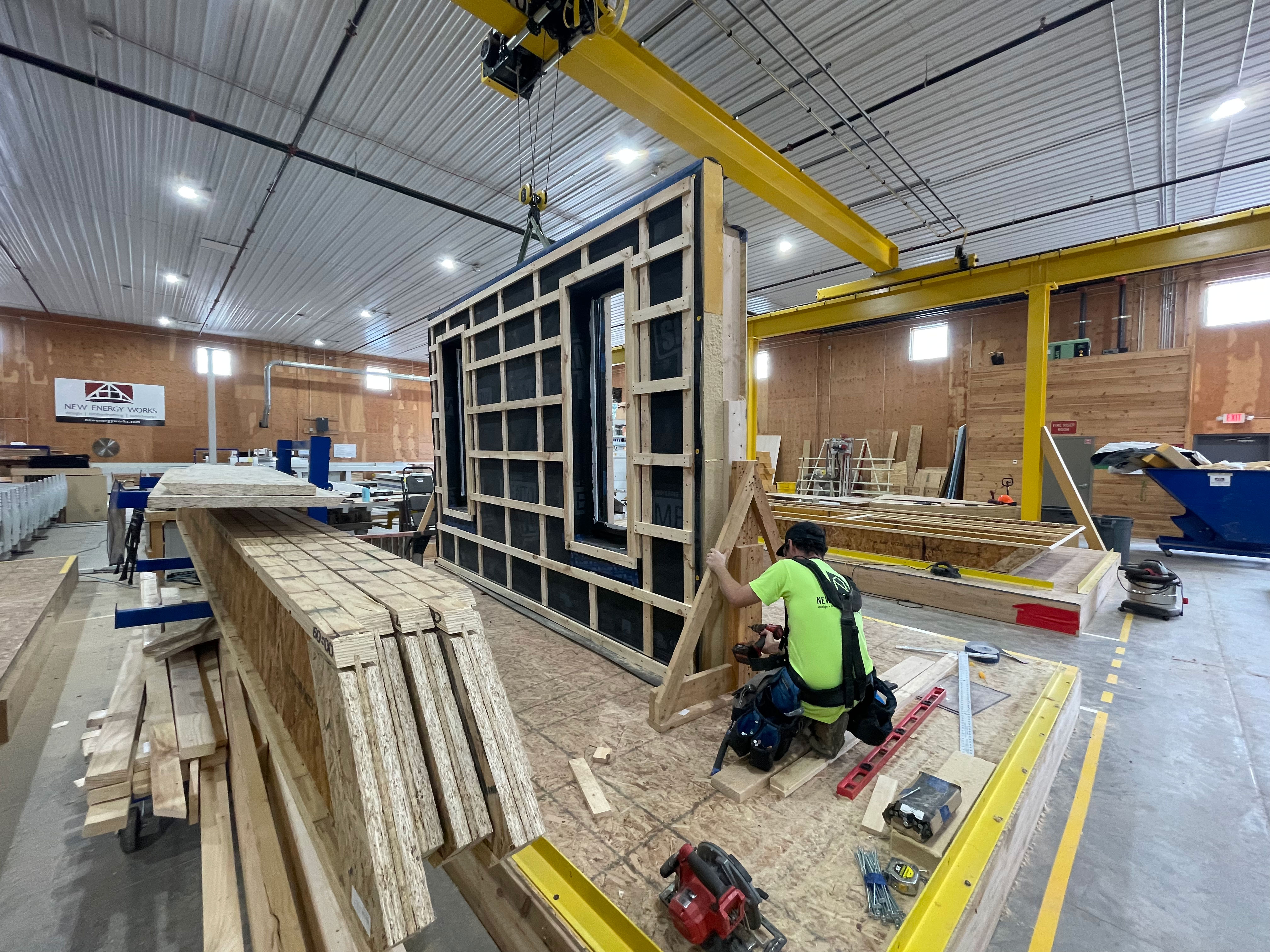
A look inside the New Energy Works facility. All photos courtesy of New Energy Works
Published: August 18, 2026