By the Passive House Accelerator Team

New Frameworks Joins Passive House Accelerator as a Patron Sponsor

Passive House Accelerator is pleased to announce that New Frameworks has joined the Accelerator community as a Patron Sponsor. Founded in 2006 and based in Vermont, New Frameworks is a worker-owned cooperative that designs and manufactures prefabricated structural straw-insulated panels (S-SIPs) for high-performance buildings. Drawing on locally sourced, bio-based materials that include straw, native wood, lime plasters, and stone, the co-op produces homes that are healthy, comfortable, durable, remarkably efficient, and beautiful–and store more carbon than they emit.
At the heart of the company’s work is this simple, powerful idea: a wall can store carbon rather than add it to the already-overloaded atmosphere, and natural materials are the key to making that idea a reality. Chief among them is straw, a byproduct of agriculture. It is the woody stalk of the cereal grain plant, made of essentially the same cellulose and lignin as wood. To make that cellulose and lignin, plants pull carbon dioxide from the atmosphere as they grow. Rather than returning that carbon dioxide to the atmosphere or into the ground during decomposition, compressed straw is packed into a sealed, vapor-open double-stud panel that locks that carbon into the building for its entire life, with no petrochemical binders or treatment. The result is an enclosure that can be net carbon-storing, drawing down more carbon than the rest of the structure emits. Scaled across the low-rise residential construction the country needs anyway, that shift is enormous: the same homes built with conventional, high-embodied-carbon materials would release tens of millions of tons of CO2e, while carbon-storing assemblies can turn that construction into a carbon sink.

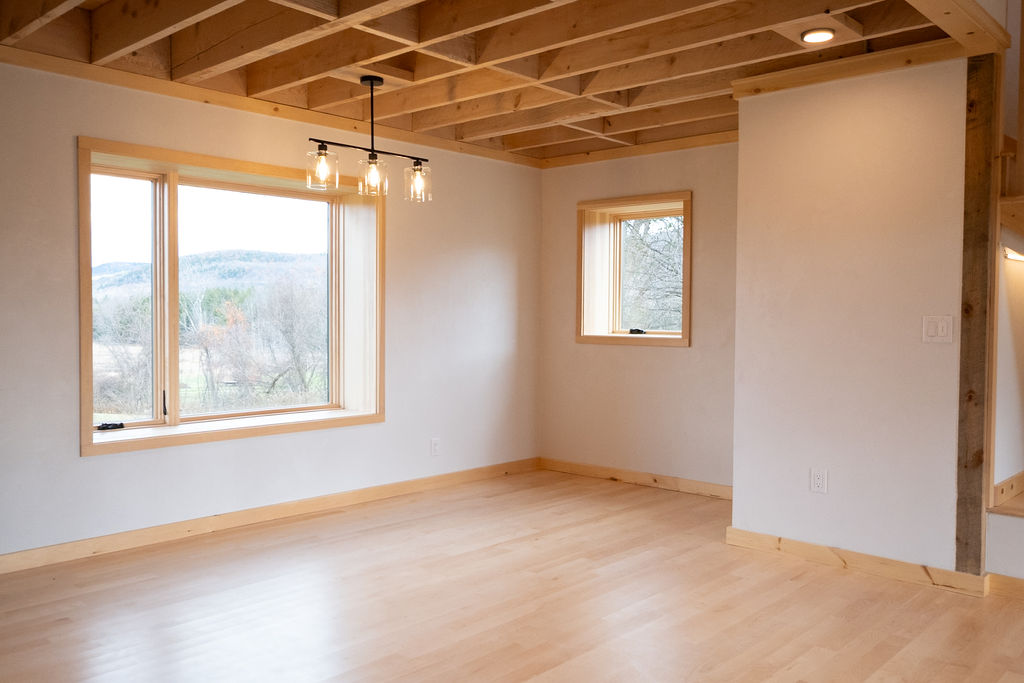

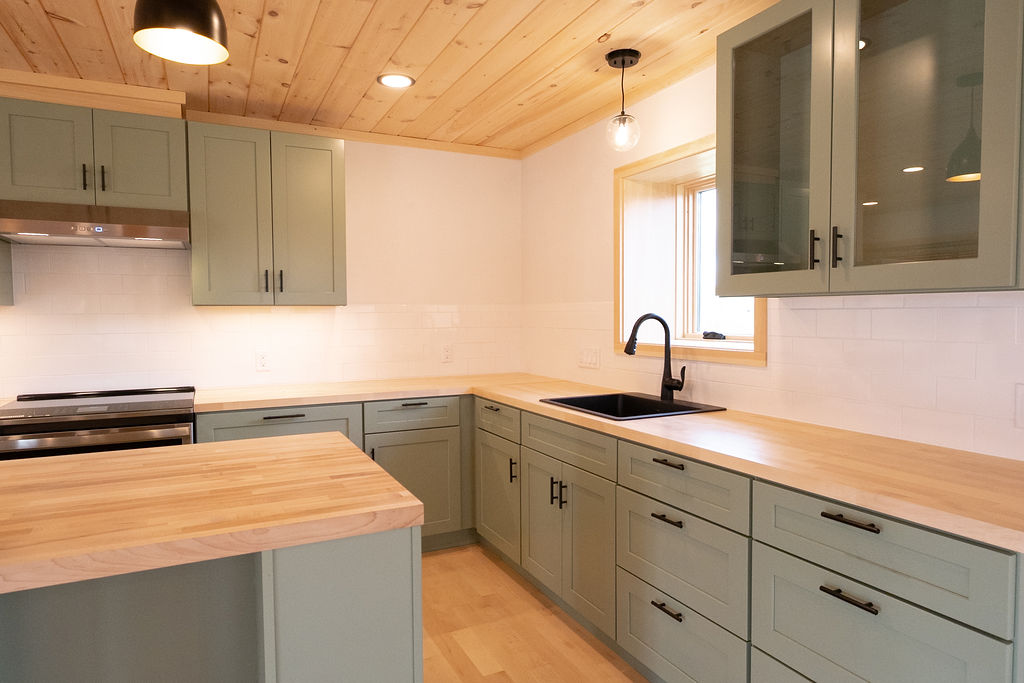

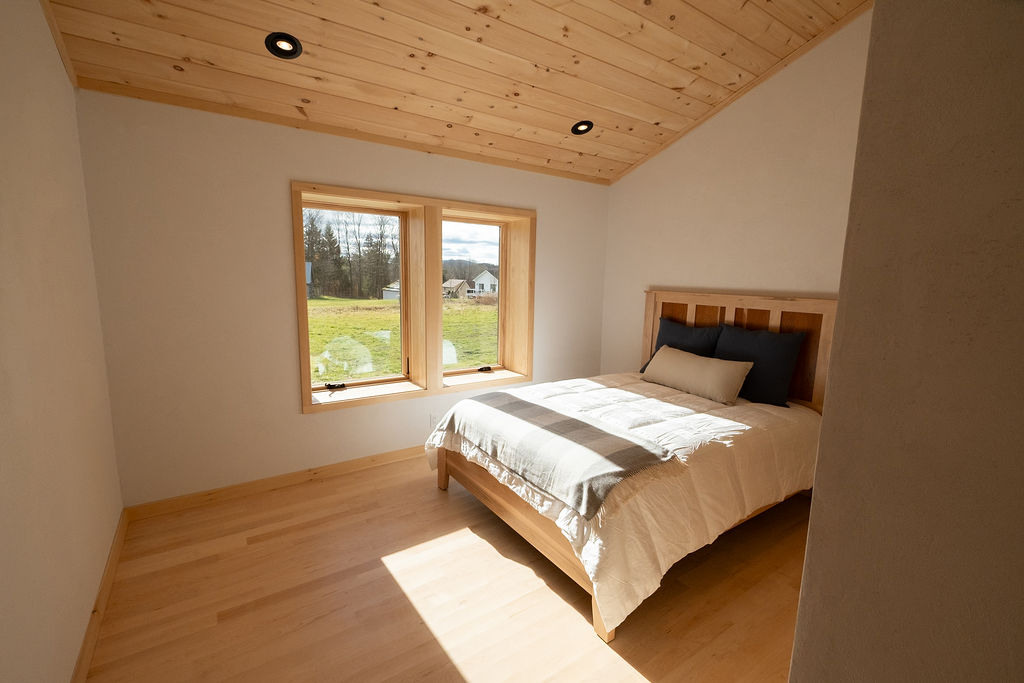
In addition to its carbon sequestering power, straw is also an extremely effective insulator. New Frameworks’ panels carry accepted R-values in the high-30s to low-40s, and they can be wrapped to reach R-60 or beyond. Moreover, they are designed to be airtight and minimize thermal bridging, ensuring their alignment with the Passive House principles. As a result, New Frameworks’ S-SIPs help project teams and homeowners dramatically reduce embodied carbon and operational carbon simultaneously. Their first straw panel project, in Leydon, MA, in 2019, was a certified Passive House.
New Frameworks has distilled more than two decades of natural-building experience into the Casitas, a line of pre-designed homes ranging from roughly 400 to 1,200 square feet. All-electric, concrete-free, and carbon-storing, the Casitas are fully panelized, so floors, walls, and roof assemble on site much like a Lego kit, with interior finishes pre-specified to keep schedules fast and costs predictable. Fabricated in the shop and shipped as a kit anywhere in the country, they are designed as a direct, replicable answer to the intertwined housing, affordability, and climate crises, as they are quick to build (an enclosure can be completed in about two to three weeks) and not resource intensive.

As the parent company, New Frameworks is also the origin of the Seed Collaborative, a growing, decentralized network of regional manufacturers producing S-SIPs across North America. Rather than treating straw panels as proprietary, New Frameworks treats the technology as open-source and teaches other firms to build panels through the Seed Program, a three-year business incubator. As companies graduate, the network expands, keeping material sourcing and jobs local while collectively accelerating the adoption of regenerative, carbon-storing construction. It is an approach rooted in New Frameworks’ identity as a cooperative built around climate and community, and one that aims to scale high-performance building through collaboration rather than competition. At present, the Collaborative’s network includes manufacturers in Massachusetts, the DC metropolitan area, Missouri, Washington State, and Colorado–with manufacturers coming online in Minnesota, California, Oregon, Ohio, and New York State in 2027.

“We know what we need to do to slow and reverse climate heating, and in the AEC industry we have the unique opportunity to take the 40% global carbon emissions we’re currently responsible for and not only bring that to zero—but reverse that to 40% carbon drawdown and storage resulting from our work,” said New Frameworks co-founder Ace McArleton. “That drive—to save the world and build the one we collectively deserve—is at the heart of what we do here at New Frameworks and the destination. Straw panels are the vehicle.”
“In addition to the sustainability aspects to the straw panels, there is a really broad set of value propositions that invite many stakeholders to join this movement and use these materials. We are investing in local economies, in agriculture economies, in local and diversified manufacturing enterprises, and regional-scale development in both manufacturing and housing—to have a broad set of housing and delivery options that can be adjusted on a regional basis," added New Frameworks co-founder Jacob Deva Racusin. "All of this is deeply cross-cutting and helps support scalable implementation for folks for whom sustainability might not be a priority, or might even be a liability in certain communities. They can still find a tremendous amount of value in the local economics, or in workforce development and domestic manufacturing. These are values that may resonate really strongly in communities where focusing on climate change hasn’t been a main priority.”

“There’s a real shift happening in how our community thinks about materials, and New Frameworks sits right at the leading edge of it,” said Passive House Accelerator Director Zack Semke. “They’ve shown that a wall can actually store carbon, support local farms and mills, and keep the people who live and work with it healthy. Pairing that with a fast, affordable prefab approach is exactly the kind of thinking we want to amplify, and we’re honored to welcome them as a Patron Sponsor.”
Passive House Accelerator Founder Michael Ingui said, “What New Frameworks is building is bigger than a great product. Through the Seed Collaborative, they’re putting the know-how in the hands of regional manufacturers all over the country and proving that natural and carbon-storing materials can scale. Our audience is hungry for exactly this kind of thing: healthy materials, low embodied carbon, and a prefab model that meets the housing crisis head-on. I couldn’t be more excited to welcome them to the community.”
To learn more about New Frameworks, the Casitas, and the Seed Collaborative, you can check out their page on the Accelerator site or visit newframeworks.com.