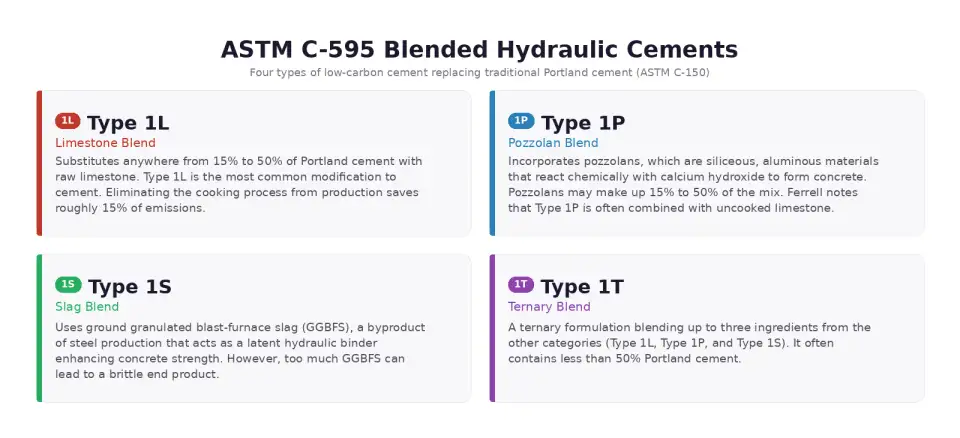
Beyond these base formulations, Ferrell outlined a growing inventory of materials being introduced into cement mixes:
Fly ash (a byproduct of coal combustion)
Bottom ash (a coarser, heavier byproduct of coal combustion with more heavy metals)
Ground glass
Electronic blast-furnace slag
Mine tailings
Calcined clays
Biochar (a form of charcoal produced by heating organic material in a low oxygen environment)
The chemistry of the raw limestone itself also varies by region. The best deposits in the United States are in the Ohio River Valley, where one finds a variety of limestone (dolomitic limestone) composed primarily of calcium magnesium carbonate rather than calcium carbonate. Dolomitic limestone is harder and less absorbent, and cement made from this type of limestone performs differently from other sources on the Blaine test, which measures particle fineness.
What Teams Are Seeing in the Field
As Ferrell noted, the transition has not been seamless. Cement producers initially believed that the new types were equal replacements for ASTM C-150. This has not been the case. There are differences. Moreover, producers are not offering a universal alternative. Many project teams have no idea what they're getting unless they ask their producers directly.
The consequences are showing up across the country. Ferrell outlined the placement issues first: unpredictable set times that leave crews guessing when they can put trowels on slabs; color uniformity problems where just a few degrees of temperature change between pours results in visible differences; poor floor flatness or floor levelness; delamination; and delays in passing early strength tests. The final product may also be less aesthetically pleasing due to longer cure times and reduced workability.
Post-placement, the problems compound. Slabs may fail to meet owner specifications for levelness, color, or aesthetics. Latent issues can surface after the HVAC comes on, requiring remediation after the building is sealed in. The floors tend to be more porous, meaning accidental stains penetrate deeper and are harder to remove. As a specific example, Ferrell described a data center where crews ran power trowels on the slab for an extra 20 minutes to an hour to achieve the desired finish. The heat and friction brought hydrophobic polymers to the surface, causing water to exude from the concrete and to bead on the surface.
For high-performance building practitioners, there is an additional concern: the increased presence of limestone powder can interfere with the adhesion of control layers—a critical issue when airtightness and moisture management are non-negotiable.
How the Industry Is Adapting
The American Concrete Institute (ACI), the American Society of Concrete Contractors (ASCC), and ASTM International are working to move beyond anecdotal evidence and provide empirical data and actionable strategies to assist in the transition. These agencies are working with government, academic institutions, and private industry to fund studies into how net-zero solutions for cement production perform, since Ferrell cautioned that not every solution performs as advertised. "There's a trial and error for what works and what doesn't work," Ferrell said.
He also raised a concern that should resonate deeply with the Passive House community: "The goal (of eliminating emissions from cement production) is good, but durability is not high enough on the priority list." A building should last 80 to 100 years, and Ferrell expressed uncertainty about whether some recent concrete construction will meet that standard.
PROSOCO's Solutions for the ASTM C-595 Era
PROSOCO is helping lead the industry's response with a comprehensive lineup of products for surface preparation, densification, protective treatments, and maintenance. These products have been evaluated and refined specifically for ASTM C-595 applications.
For surface preparation
For protection
For densification
PROSOCO also offers densifiers formulated specifically for ASTM C-595 cements.
DensiKure cures and densifies new concrete in a single step.
BD1 is a high-performance silicate blend designed for Type 1L and other ASTM C-595 surfaces.
Blended Densifier is a concentrated formulation for steel-troweled and burnished floors.
The Bottom Line
Low-carbon cement is here to stay, and for good reason. Emissions reduction is essential. However, the transition from carbon-intensive Portland cement to its low-carbon alternatives will demand new knowledge, new coordination, and new products tuned to the realities of ASTM C-595 chemistry. Ferrell's session made one thing clear: understanding what's in your cement is no longer optional.
To learn more, watch the full Component Spotlight recording on YouTube, visit PROSOCO's website, or explore their concrete flooring product line to find the right solutions for your next project.