web 981 davie st exterior render 1 courtesy of zgf architects

Inclusive by Design: Mass Timber Meets Social Mission at Vancouver’s 981 Davie

By Jay Fox

Few buildings in Vancouver have been as highly anticipated as 981 Davie. In development since 2018, the mass timber tower recently topped out at 17 stories on the corner of Davie and Burrard streets within the city’s West End. When doors open in early 2027, the building will deliver 154 Passive House apartments, with nearly a third of them being family-oriented two- and three-bedroom units. Meanwhile, the building will contain 132,279 square feet of gross floor area above grade, a Passive House conditioned area of 134,619 square feet, and a site footprint of just 13,500 square feet within the city’s downtown core.

The size of the landmark project is certainly impressive, but so too is the social mission imbued within the design, as its sustainability goals have been paired with efforts to create a welcoming and inclusive space for all and to provide much-needed family-oriented units within Downtown Vancouver. As we’ll explore, these social components are the backbone of the project in many ways.

The level of institutional knowledge baked into the project is also impressive. The Community Land Trust Foundation of B.C., 981 Davie’s owner and operator, has already completed one Passive House project. Meanwhile, ZGF Architects have long been advocates of Passive House design and the use of bio-based materials. Their portfolio includes RMI’s Innovation Center in Basalt, CO; the PAE Living Building in Portland, OR; and the main terminal expansion at Portland International Airport, which now feels less like a busy transit hub and more like a forest. Kindred Construction, the general contractor, has familiarity with both mass timber and Passive House construction, as evidenced by their groundbreaking work on projects like the nearby Vienna House.

The team’s familiarity with high-performance building helped set the tone from the start and to integrate performance targets into the earliest stages of design. Early coordination also allowed them to create a fundamentally different kind of building that prioritizes performance but is also meant to enrich both the lives of its residents and the surrounding community.

web 981 davie st exterior render 2 courtesy of zgf architects

Project Team

Renderings courtesy of ZGF Architects

Prioritizing Accessibility, Visibility, and Connectivity

Beyond seeking certification through the Passive House Institute (PHI) and using mass timber, 981 Davie stands out for the degree to which its social mission has been embedded into the building’s DNA. “Design decisions were guided by a commitment to creating inclusive environments that support well-being and social connection,” says ZGF Architects Associate Principal Daniel Wilson.

Perhaps most notably, the project is intended to celebrate and provide supportive services to members of Vancouver’s 2SLGBTQIA+ community, which for decades has been centered in the West End’s Davie Village. The first two floors of the building will include 13,000 square feet for Qmunity, a community-based organization that provides low-barrier mental health care and social services to queer, trans, and Two-Spirit peoples.

Since 1978, the organization has operated out of a 3,000-square-foot space on the second floor of a building located at the corner of Davie and Bute streets—about two blocks away from 981 Davie. Unfortunately, there is no elevator service, which has long presented accessibility problems for visitors. The new home at 981 Davie eliminates the issue but also dramatically increases the organization’s visibility on Davie Street. Placing Qmunity at street level reinforces Davie Street’s identity as an inclusive and affirming space for all, particularly Vancouver’s 2SLGBTQIA+ community, and serves as a powerful metaphor for the project: that visibility, accessibility, and safety for marginalized communities are foundational tenets of the building.

Photo courtesy of ZGF

Project Details

  • Location: Vancouver, British Columbia

  • Units: 154

  • Above Grade Gross Floor Area: 132,279 ft2

  • Conditioned Area: 134,619 ft2

  • Site Area: 13,500 ft2

  • Structure: Concrete podium with mass timber

  • Windows: Innotech Defender 88PH vinyl

  • Completion: Early 2027

Photo courtesy of ZGF

Above Qmunity’s space, residents will have access to a range of shared amenities designed to support day-to-day living and promote connectivity. They include communal lounges, work and study areas, and games and recreation rooms, as well as shared terraces (on the seventh floor) and common laundry rooms (on floors four and six) deliberately positioned adjacent to larger amenity zones. In addition to encouraging casual interaction, the strategy allows for spaces to evolve as needs change, with the potential for partnerships and programming to be accommodated as the community grows. “While the building is primarily residential in nature,” says Wilson, “the amenity spaces are designed to support informal supportive foundations—such as social connection, collaboration, and community-building—rather than formal on-site social or clinical services.”

Wilson notes that building layouts also emphasize natural light and a sense of balance between private and communal spaces. “Together, these elements create a supportive, inclusive environment for residents and the broader community while helping to reduce social isolation,” he says.

Look Inside
Illustration courtesy of ZGF

Mass Timber and Mass Transit

Though the building is 17 stories tall, 981 Davie was designed to be respectful of the existing streetscape and to be non-imposing. “Step-backs above the podium level reduce the perceived scale of the tower, improve access to daylight, and minimize shadow and overlook impacts on neighboring buildings,” Wilson says.

As a result, the building is sensitive to the context of the surrounding neighborhood and promotes an active corner, while also optimizing density and performance. Additionally, there were strict limitations because of view cone requirements and rigorous guidelines governing tower setbacks from adjacent properties above the sixth floor. These regulatory constraints, combined with the site’s relatively compact footprint and corner conditions, were the primary influences for the building’s massing and orientation.

These design considerations are clear to casual observers along the street, but what they may not notice is the vital role mass timber plays in the construction of the floors above the podium. Though timber is not central to the aesthetics of the building exterior, the material is a core part of the project’s identity, as it reflects the team’s broader commitment to sustainability, innovation, and wellness via biophilic design. Additionally, several governmental agencies stepped in to support the use of mass timber on the project, as 981 Davie was intentionally conceived as a publicly funded demonstration of innovative, high-performance building practices.

“It is a project designed to show what is possible when advanced construction methods meet a rigorous performance standard. Mass timber aligned with those goals on several fronts: it enabled efficient, prefabricated construction sequences, supported Passive House performance objectives, and significantly reduced the project’s embodied carbon footprint compared to conventional concrete construction,” Wilson says.

The structure uses a hybrid approach that includes mass timber, steel, and concrete. The two-story podium and two below-grade parking levels handle the heavier structural demands. Above, the structure transitions to a mass timber superstructure, with cross-laminated timber (CLT) floor panels spanning between glulam beams that are supported by steel hollow structural section (HHS) columns. A reinforced concrete core serves as the backbone of the building, extending the full height of the 17-story tower.

“The system leverages each material for its highest and best use,” Wilson says; “Concrete for stiffness and lateral stability, steel for compressive strength, and mass timber for lightweight, sustainable floor construction.”

Beyond the use of mass timber, the project team pursued additional embodied carbon reduction strategies. These include the use of prefabricated building components to minimize material waste and on-site construction impacts, as well as the selection of durable, long-life materials to reduce lifecycle carbon by minimizing future replacement and maintenance.

The below-grade parking levels are relatively small, and the ratio of car to bicycle parking spaces is 13 to 260, as Vancouver’s density and transit system make car ownership unnecessary for many people. Beyond being within a walkable neighborhood, 981 Davie is located at the intersection of multiple bus lines traveling Burrard and Davie streets, and it is a quick walk to Granville Street, along which operates another six bus lines. This kind of infrastructure allowed the team to lean hard into its identity as a transit-oriented development, another decision that reflects both environmental values and the realities of its dense urban context in one of Vancouver’s most walkable neighborhoods.

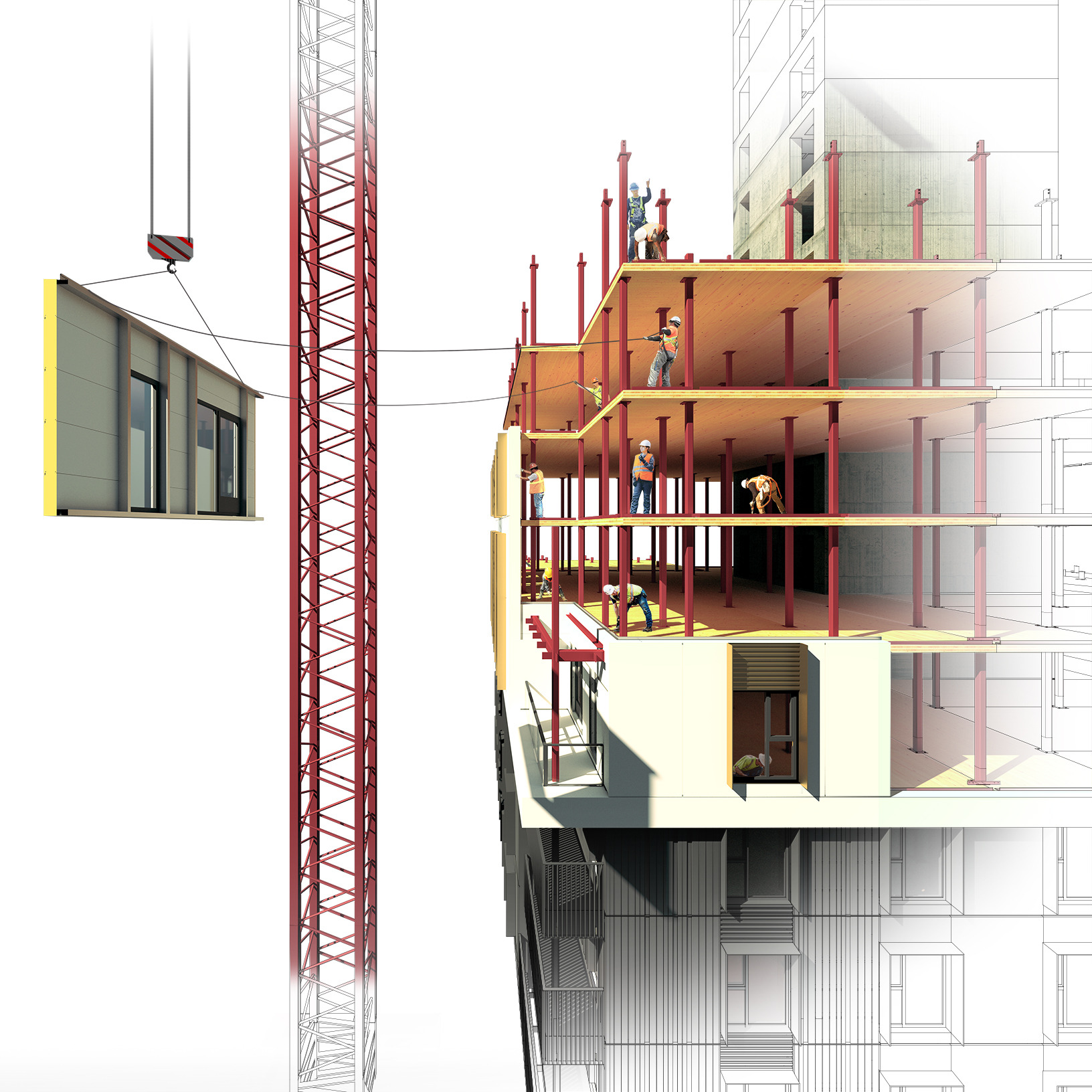
Achieving Passive House certification on a 17-storey tower demands rigorous attention to the building envelope, and the 981 Davie team took an approach optimized for both thermal performance and constructability. The wall assemblies for stories three and above rely on a prefabricated envelope system known as Speedwall. Developed by Flynn, the Speedwall system combines aluminum curtain wall sub-framing, Kingspan Quadcore insulated metal panels, triple-gasketed vertical and horizontal stack joints, and metal girts with prefinished metal panel cladding. In addition to delivering an effective R-value of 33, the prefabricated approach is repeatable across the tower’s façade and (as the name suggests) allows for a speedy build once construction is underway.

Look Inside
Figure 1. Construction details courtesy of ZGF

Wrapping a Tower in Passive House Performance

Achieving Passive House certification on a 17-storey tower demands rigorous attention to the building envelope, and the 981 Davie team took an approach optimized for both thermal performance and constructability. The wall assemblies for stories three and above rely on a prefabricated envelope system known as Speedwall. Developed by Flynn, the Speedwall system combines aluminum curtain wall sub-framing, Kingspan Quadcore insulated metal panels, triple-gasketed vertical and horizontal stack joints, and metal girts with prefinished metal panel cladding. In addition to delivering an effective R-value of 33, the prefabricated approach is repeatable across the tower’s façade and (as the name suggests) allows for a speedy build once construction is underway.

Floors one and two consist of a traditional site-built exterior insulated steel stud assembly (see Figure 1) that includes an exterior sheathing layer, a self-adhered air and vapor barrier membrane, eight inches of mineral wool insulation, and prefinished metal panel cladding that is connected to the façade with thermal isolation clips and metal girts. The effective R-value is 32. Below grade, the envelope strategy shifts to a conventional waterproofing membrane paired with XPS rigid insulation, achieving an effective R-value of 25. The foundation is a conventional mat foundation with sub-slab XPS insulation at the same R-25 level.

The roofing system uses an inverted assembly at both the terraces on the seventh floor and the main roof. A two-ply SBS (styrene-butadiene-styrene) waterproofing membrane is installed below the insulation layer, providing enhanced durability and long-term protection. XPS insulation sits above the membrane, delivering thermal performance of approximately R-35. The XPS was selected for its compressive strength and moisture resistance—critical properties in an inverted roof where the insulation sits above the waterproofing and is directly exposed to water drainage.

Fenestration is split between two systems tailored to different conditions within the building. At the commercial Qmunity levels (floors one and two), the project uses Reynaers CW50-HI curtain wall—a high-insulation aluminum system suited to the larger glazing spans of the ground-floor public spaces. From level three through seventeen, the residential floors use Innotech Defender 88PH+ Pro uPVC windows and doors, a PHI-certified system that balances thermal performance with cost efficiency across the hundreds of window openings in the tower.

Conditioning 154 Suites, One at a Time

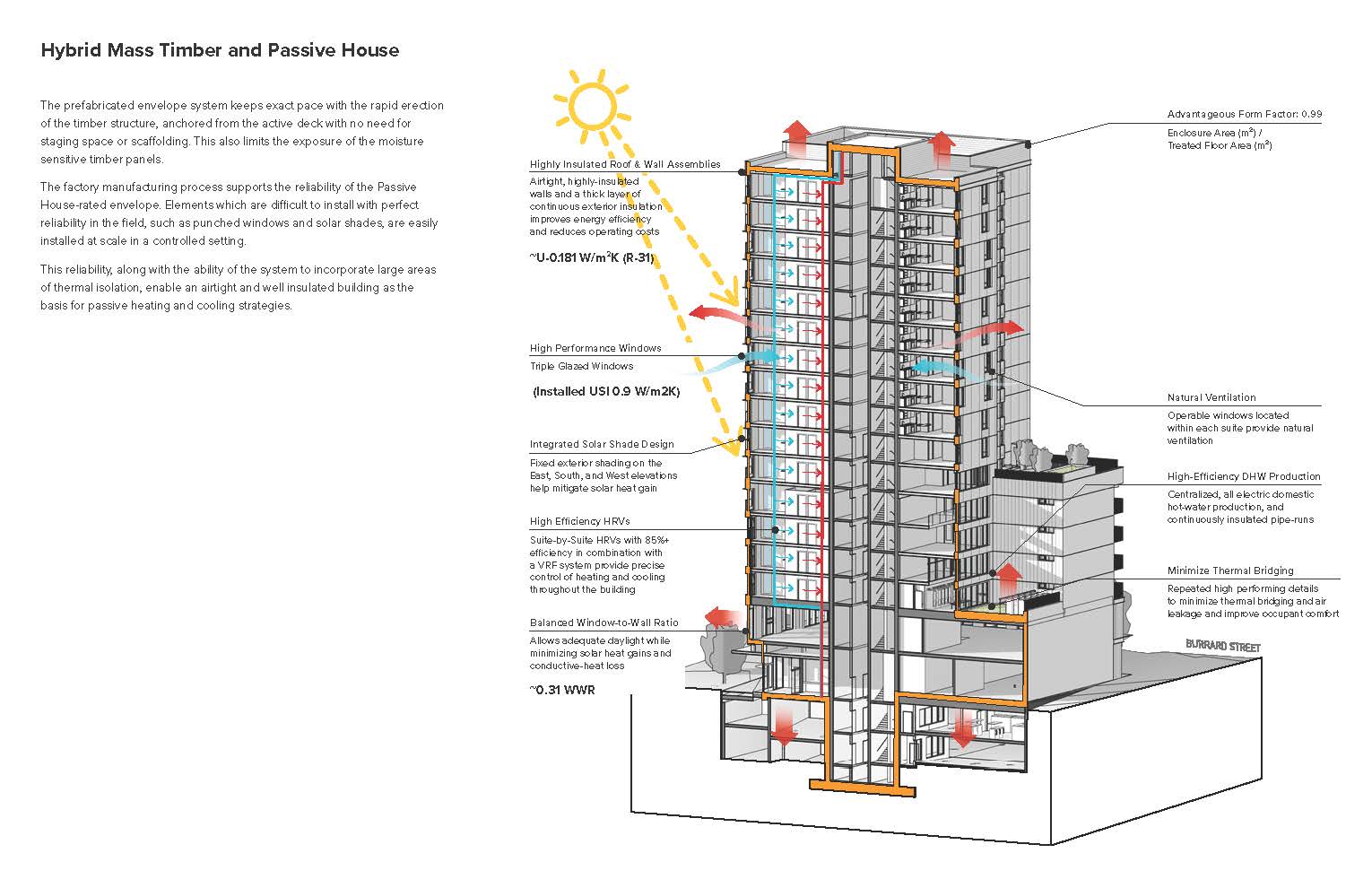
The mechanical strategy at 981 Davie is predominantly decentralized, with heating, cooling, and ventilation systems operating independently within each residential unit. Each suite is equipped with its own high-efficiency heat recovery ventilator (HRV), rated at approximately 85 percent heat recovery, providing continuous balanced ventilation with minimal thermal loss and supporting the Passive House performance targets that define the building. Heating and cooling are delivered through a variable refrigerant flow (VRF) system that enables individual temperature control and efficient part-load operation across the building.

Photo courtesy of Marcus Cantagallo

The decision to go suite-by-suite was driven primarily by physical constraints: limited floor-to-floor heights left insufficient ceiling space for the kind of complex ductwork needed for centralized systems. The decentralized approach also offered advantages in occupant control, system redundancy, and alignment with Passive House performance targets. Each unit operates independently, ensuring consistent indoor air quality and precise thermal comfort regardless of what is happening elsewhere in the building. This level of individualized control is a meaningful benefit in a 154-unit tower where occupancy patterns, cooking habits, and temperature preferences vary widely.

Overheating was a key design consideration from early in the process. Despite being in British Columbia, which has historically been temperate enough not to require dedicated cooling systems for many projects, the combination of a high-performance envelope, residential density, and warming climate trends made summer cooling a serious concern. BC Housing even flagged overheating as a major concern that could diminish thermal comfort. In response, the centralized VRF system provides active cooling to all suites and building uses. For passive cooling, fixed solar shading is incorporated into the facade design, and the many taller buildings in the surrounding area provide additional shading to help limit solar exposure and further mitigate overheating risk during peak summer conditions.

Installing the prefabricated panels with the Innotech windows (and in some cases Juliet balconies) already installed. Photo courtesy of ZGF

Lessons for the Next Team

Asked what advice they would give to an architecture firm embarking on its first Passive House multifamily project, Wilson’s response was unequivocal: engage Passive House expertise early and integrate it across the entire design team from the outset. Passive House multifamily projects require close coordination between architecture, mechanical, envelope, and energy modeling decisions, and early alignment helps avoid costly redesigns later. The interplay between these disciplines is tighter than on a conventional project, and decisions made in one domain—window placement, for example, or mechanical shaft sizing—ripple through the others in ways that are difficult to modify after the fact.

Investing time upfront to understand the performance targets, construction tolerances, and nuances of the detailing pays dividends throughout the project. Wilson specifically notes that the detailing around the building envelope, window layouts, and mechanical systems integration need special attention. High-rise Passive House construction is not a matter of adding special products to a conventional design process; it requires rethinking how the team collaborates from day one, with performance as a shared objective rather than a box to be checked at the end. It is a team sport that requires both clear strategies and a tremendous amount of cooperation.

Photo courtesy of Marcus Cantagallo

When 981 Davie welcomes its first residents in 2027, it will stand as proof that a building can be many things at once: a high-performance Passive House tower, a mass timber demonstration project, a transit-oriented development, and a permanent home for a community organization that has waited decades for a space worthy of its mission. On Davie Street, in the heart of the West End, those goals turned out to be not just compatible but mutually reinforcing.

Modeled Performance Metrics

Criteria

Threshold

981 Davie

Heating Demand

≤15 kWh/m²/yr

15 kWh/m²/yr

Cooling Demand

≤15 kWh/m²/yr

3 kWh/m²/yr

PER Demand

≤64 kWh/m²/yr

58 kWh/m²/yr

Airtightness

≤0.6 ACH at 50 Pa

0.6 ACH at 50 Pa

Don't Go It Alone. Join Our Community.

The Reimagine Buildings Collective brings together building professionals stepping up to tackle climate change.


Learn More About Passive House in Vancouver

Published: June 5, 2026
Author: Jay Fox